


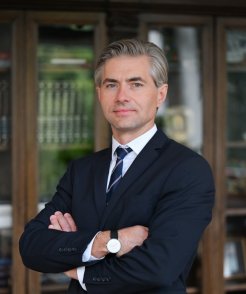
ADDRESS BY ANTANAS VALIONIS TO THE 58TH SESSION OF THE UNITED NATIONS COMMISSION ON HUMAN RIGHTS (Geneva, 19 March 2002)
Minister of Foreign Affairs of Lithuania in his capacity of Chairman of the Committee of Ministers of the Council of Europe
Mister Chairman,
Madam High Commissioner,
ladies and gentlemen,
Allow me, at the beginning of my statement, to congratulate you, Mr. Chairman, and the Bureau of the Commission on the election to this high post. Also I would like to congratulate our host country – Switzerland - on its decision to join the United Nations family.Mr. Chairman,Being established in the aftermath of the Second World War, the Commission on Human Rights was determined to bring into reality the principles enshrined in the UN Charter and to become a practical instrument for investigating and calling attention to violations of human rights as well as a forum for international discussion, consensus-building, and action. It is our responsibility now to do all we can to fulfil the high purpose of the Commission’s founders.Today’s world is a complicated one. Terrorism, acts of violence in the Middle East, human rights situation in a number of countries, challenges of globalisation all add to human insecurity. Terrorism, and especially the horrific terrorist acts of 11-th of September in the United States in its most shocking form, sets many challenges to the purposes and principles of the United Nations – international peace and security, human rights, human development and the rule of law. Promotion and protection of human rights should be at the centre of strategy to counter terrorism.Mr. Chairman,This session is one of the starting points to the follow-up of the World Conference against Racism, Racial Discrimination, Xenophobia and Related Intolerance. Among the most significant parts of the Durban Declaration and Programme of Action are strategies developed to combat discrimination and intolerance and they are a powerful tool to foster social harmony. I would like to personally emphasize the importance my country attaches to bringing the decisions made in Durban into action. They, together with the concluding observations and recommendations on Lithuania’s report on implementation of the International Convention on the Elimination of All Forms of Racial Discrimination form the basis for Government action.Mr. Chairman, I have the pleasure to participate here today not only in my capacity as the Minister of Foreign Affairs of Lithuania, but also in a one more very important capacity - as a Chairman of the Committee of Ministers of the Council of Europe. One of Lithuania’s chairmanship priorities in the Council of Europe - to seek to increase coordination and complementarity between the UN and Council of Europe.Excellent relations between the Council of Europe and the United Nations already exist. There are regular contacts at all levels, from the High-level Tripartite Meetings and Target-oriented meetings to working level contacts between secretariats, including missions on the ground.But also I believe, that the Council of Europe experience in regional co-operation for the promotion and protection of human rights provides possibilities for the effective sharing of the best practices and experiences with UN member states.As a regional organisation with a mission to safeguard and promote democracy, human rights and the rule of law, the Council of Europe makes an important contribution to the furtherance of the aims of the United Nations. The Organisation does so especially through its human rights treaty mechanisms and the monitoring systems. I am very pleased that the Council of Europe’s contribution was duly recognised in the Resolution adopted by the 56th session of the General Assembly last December, which was introduced by my country, Lithuania, together with Latvia, Liechtenstein and Luxembourg. These were such spheres of Council of Europe contribution such as to the Durban Conference, to international action against terrorism, implementation of the Security Council Resolutions and the Stability Pact and others.Certainly in the human rights field, such cooperation is not only desirable, it has become a necessity, simply because more and more, both Organisations work on similar human rights questions. Each does so within its own competences and in accordance with its own political priorities. However, it is important that both Organisations are fully aware of each other’s work and that, where possible, opportunities for pragmatic forms of cooperation are identified. Mr. Chairman,At the 109th session of the Committee of Ministers last November, the Ministers made the commitment that the Council of Europe will contribute, within its areas of competence, to international action against terrorism in all its forms and manifestations and the factors likely to fuel it. This contribution is designed to support and sustain the international strategy to combat terrorism. It has three cornerstones, which form part of an integrated approach. The first involves more intensive legal cooperation to combat terrorism, inter alia, through improving existing Council of Europe international instruments. Secondly - the Ministers reaffirmed that measures against terrorism must remain consistent with the requirements of democracy, the rule of law and human rights. Currently, human rights guidelines are being drawn up within the Council of Europe, based on the case law of the European Court of Human Rights. This experience could be of interest also to the Commission on Human Rights. Thirdly, Council of Europe work to promote a wide intercultural and inter-religious dialogue, activities fostering greater social justice, fight against intolerance and discrimination must be mentioned in this context. Mr Chairman,The Council of Europe hosted in October 2000 the European regional preparatory conference for the World Conference against racism, racial discrimination, xenophobia and related intolerance, which took place in Durban in September 2001. The Durban Conference emphasised the need for determined action, both at international, regional, national and local levels, carried out by governments in conjunction with civil society. The Council of Europe is ready to join collective efforts at European level in ensuring the action needed to implement the recommendations of the World Conference. To this end, a meeting was organised in Strasbourg at the end of February, with Council of Europe member States, relevant Council of Europe and EU bodies, representatives of the Office of the UN High Commissioner for Human Rights and of NGOs, to exchange views on the outcome of the World Conference and future strategies to combat racism. Also, the European Commission against Racism and Intolerance intends to launch an action programme on intercultural dialogue on 21 March, the International Day for the Elimination of Racial Discrimination. I believe that this initiative is highly important also in the post – 11-th September context.Mr Chairman, The Commission on Human Rights does vital work on the question of the death penalty. Its resolutions on this question rightly set priority on the establishment of a moratorium on executions. Thanks to abolition of the death penalty in almost all member States of the Council of Europe and to moratoria in the three other States, no executions have taken place in our geographical area since 1997. The Council of Europe’s commitment towards abolition has recently led to the adoption of a new Protocol to the European Convention on Human Rights, which abolishes the death penalty in all circumstances, also for crimes committed in time of war or of imminent threat of war. I am pleased to announce that this Protocol will be opened for signature in Vilnius, Lithuania, on 3 May 2002, during the session of the Committee of Ministers of the Council of Europe.Mr. Chairman, Let my comment a few words on Lithuania’s national programmes for the protection and promotion of human rights.Global ratification of the basic treaties of the UN human rights treaty system and acceptance of the principles set in these documents has an unquestionable importance. Ratification of human rights treaties provide necessary conditions for reforms of national legislation bringing it into conformity with the treaties, reports by monitoring bodies provide basis for further development of this process. Lithuania views concluding observations of monitoring bodies as a basis for further development of its human rights protection. This year the Lithuania’s report on implementation of the International Convention on the Elimination of All Forms of Racial Discrimination was examined and the concluding observations on it is an important guidance for the Government of Lithuania. The network of Lithuanian human rights protection laws and institutions is also being influenced by the alignment of Lithuanian laws with the European Union’s. For example, one of the most important programmes adopted since the last Commission on Human Rights is a Programme for Prevention and Control of Trafficking in Persons and Prostitution for 2002-2004. Also, in 2001, Lithuania, UNDP and the Office of the UN High Commissioner for Human Rights have started a Project on the Preparation of a National Human Rights Action Plan, based on the national priorities of human rights, which constitutes a very important step in the development of national capacities for the promotion and protection of human rights in Lithuania.Thank you, Mr. Chairman.
Social media


