Conference “From Lita to Paris. Following the footsteps of Lithuanian Jews in France”
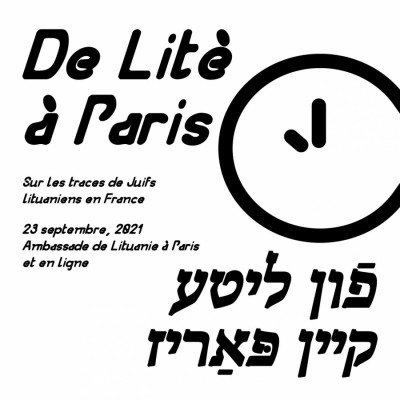
September 23, the anniversary of the liquidation of the Vilnius ghetto in 1943, is commemorated as the National Day of Remembrance of the Genocide of Lithuanian Jews.
Conference
FROM LITA TO PARIS
Following the footsteps of Lithuanian Jews in France
September 23, 2021
Lithuanian Embassy in Paris and online (registration: https://bit.ly/3lk6OrX)*
10.00 - Opening remarks
GABRIELIUS LANDSBERGIS, Minister of Foreign Affairs of the Republic of Lithuania
DELPHINE BORIONE, French Ambassador for Human Rights, responsible for the international dimension of the Shoah, spoliations and the duty to remember
10.15 - The Litvaks, the legacy of a lost Jewish world
The Jews from the territory of historic Lithuania, which in the Middle Ages included the territory of present-day Belarus and Ukraine, are called Litvaks. Their history is of such a richness in areas related to religion, philosophy, politics, and fine arts, that there are few areas that they have not marked with their excellence. The legacy of the Litvaks spread widely, remarkably enriching Western culture – even after the Holocaust, which saw their near destruction.
Yves Plasseraud, co-author with Henri Minczeles and Suzanne Pourchier-Plasseraud of Les Litvaks (La Découverte, 2006) will tells us more about this little-known epic.
YVES PLASSERAUD is a lawyer specializing in humanitarian law and multiculturalism. Author of more than 10 books related to these questions, a large part of which deals with the Baltic States and in particular the Litvaks. Former teacher at the universities of Kaunas and Vilnius (Lithuania) as well as at the International Defense College (Paris).
Questions and answers
11.00 - Screening of the documentary film „Searching for the Vilna Gaon“
His spiritual and cultural legacy is an essential part of the history of the Litvaks. However, much about the legendary figure of the Vilna Gaon (1720-1797), Talmudist, halakhist, kabbalist and thinker, eminent representative of the Lithuanian Jewish community, remains a mystery to this day. Director Vytautas Puidokas attempts to unravel it in his short documentary.
2020 | Documentary, animation | 7 min | Lithuania
Direction, scenario Vytautas Puidokas
Animation Eglė Davidavičė
Image Linas Žiūra
Music Arkady Gotesman, Paulius Kilbauskas, Vygintas Kisevičius
Production Dagnė Vildžiūnaitė (Just a Moment)
VYTAUTAS PUIDOKAS, Lithuanian documentary film director, interested in social movements and migration topics. In 2020, he has been nominated with “A Silver Crane”, Lithuanian cinema award, for the best documentary feature “El padre médico” (2019).
11.10 - The contribution of Lithuanian Jews to Yiddish cultural life in France
Although Jews from Poland were largely in the majority among Yiddish-speaking immigrants in France, those of Lithuanian origin played an essential role in the local development of this culture, from before the World War I until the end of the 20th century. As writers or as inspirers of community life, the “litvakès”, as they are called in Yiddish, stood out very particularly.
YITSKHOK NIBORSKI was born in Buenos-Aires (Argentina) in 1947. In France since 1979. He has been teaching Yiddish Language at Inalco, is a co-author of two Yiddish dictionaries and of several articles on literature in this language.
AKVILĖ GRIGORAVIČIŪTĖ was born in 1986 in Vilnius and has lived in Paris since 2009. She has been doing research on Yiddish culture in the Baltic States. She is also a translator and a board member of the Paris Yiddish Center.
Questions and answers
12.30 - Break
14.30 - Jewish, French and European identity in the thought of Emmanuel Levinas
Born in Kaunas, Russian Empire at the time, Emanuel Levinas graduated school in independent Lithuania, and studied philosophy in France and Germany, before becoming one of the most important European philosophers of the 20th century, while holding on to his Jewish identity throughout his life. His multifaceted biography reflects Europe’s diversity and multiplicity. This panel will discuss European idea and identity through the lens of Levinas’s life story and his thoughts.
DANIELLE COHEN-LEVINAS is a philosopher and musicologist, professor at the Faculty of Letters of the University of Paris-Sorbonne, where she teaches the philosophy of music, contemporary and Jewish philosophy. She is the founder and head of the “College of Jewish Studies and Contemporary Philosophy” (Emmanuel Levinas Center) and the associate researcher at the Husserl Archives of the ENS-CNRS in Paris.
VIKTORAS BACHMETJEVAS is an associate professor at Vytautas Magnus University in Kaunas, Lithuania. He works in the field of continental ethics, with a special interest in its intersections with philosophy of religion. He has published on Kierkegaard, Levinas and 20th-century French philosophy.
ELÉA PIRES is a PhD student in History of Philosophy, University Paris - Sorbonne. Fields of study: Philosophy, metaphysics, ethics, works of Emmanuel Levinas, works of Vladimir Jankélévitch, Phenomenology.
Questions and answers
16.00 - Memory of the Shoah: between Lithuania and France
For Lithuania, the extermination of the Litvaks, Lithuanian Jews, by the Nazis and their collaborators, remains one of the darkest pages in the long-concealed history of the country.
In recent years, the Lithuanian government has undertaken considerable efforts to raise public awareness on Lithuanian Jewish culture and history, including on the Holocaust, in particular on the occasion of the 300th anniversary of the Vilna Gaon, which was widely commemorated in 2020. How successful are these efforts?
Here in France, the Shoah in Lithuania occupies an important place in the collective imagination as well. What narratives is it based upon?
Is there a way to build a shared memory, and what are the obstacles on this path?
VIOLETA DAVOLIŪTĖ is a Professor at the Institute of International Relations and Political Science, Vilnius University. She is the author of The Making and Breaking of Soviet Lithuania: Memory and Modernity in the Wake of War (2014), co-author of Everyday Representations of War in Late Modernity (2021). A specialist in matters of historical trauma, the politics of memory and national identity, she has co-edited three volumes and has published numerous articles.
DR. CAROLE LEMÉE is senior lecturer in Social Anthropology-Ethnology at the University of Bordeaux and Director of Studies at the Faculty of Social Anthropology-Ethnology. She is a member of the Passages laboratory and the Center for Social Anthropology at Vytautas Magnus University in Kaunas. She is a member of the Scientific Council of the Foundation for the Memory of Deportation, and a member of the Orientation Council of the Foundation for the Memory of Slavery. She received the medal from the City of Bordeaux for her civic commitments in favor of the fight against racism and anti- Semitism, and for her contributions in applied anthropology graciously made available for life in the city.
PHILIPPE BOUKARA was born in 1957. Historian, Coordinator of training at the Shoah Memorial. Teacher at the Collège des Bernardins. Author of numerous contributions to conferences, reviews and collective works. To be published: Afterword to the biography of Roza Shabad-Gawronska, doctor in the Vilnius ghetto, by Muriel Chochois.
JUSTINA SMALKYTĖ holds a double MA in European History from Paris Diderot University and Humboldt University of Berlin and BA in History from Vilnius University. Since 2018, PhD candidate at the Centre for History at Sciences Po Paris. Her research examines anti-Nazi resistance movements in German-occupied Lithuania (1941-1944) through the lens of material culture.
Moderated by ISABELLE MANDRAUD, journalist at “Le Monde”
Questions and answers
18.00 - Closing remarks
NERIJUS ALEKSIEJŪNAS, Ambassador of Lithuania in France
Presentation of the 2022 Kaunas European Capital of Culture memorial program, dedicated to the Jews of Kaunas
20.30 - Concert dedicated to the memory of the victims of the Holocaust
Salle Gaveau (https://www.sallegaveau.com/spectacles/muza-rubackyte-piano-1-1-1)
MŪZA RUBACKYTĖ will introduce to the French public the music of a Litvak born American virtuoso pianist and composer Leopold Godowsky, born near Vilnius, Lithuania, 150 years ago. The concert is dedicated to the memory of the victims of the Holocaust.
Program:
Léopold Godowsky (1870-1935), Sonata in E minor
Frédéric Chopin (1810-1849), Fantaisie op.49 and Sonata N2 op. 35 B flat minor, called “funeral”
MŪZA RUBACKYTĖ is a Lithuanian pianist. A graduate of the Moscow Conservatory, she enjoyed an important international career from the 1980s. She devoted herself particularly to the Lisztian repertoire and to Russian music of the first half of the 20th century.
*The conference will be held in French and English, with simultaneous translation
Registration: https://bit.ly/3lk6OrX

Social media