On the initiative of Lithuania and Ukraine, the OSCE delegations in Vienna were acquainted with human rights violations in Crimea
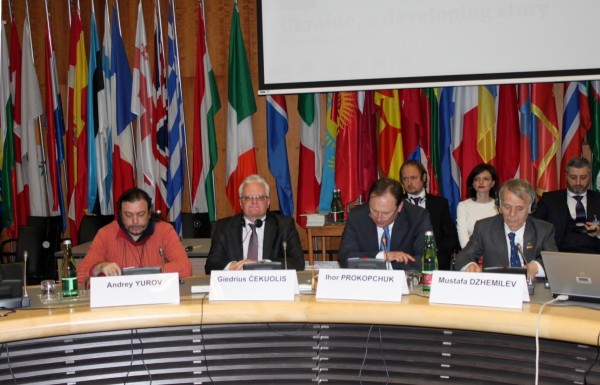
An informative event to discuss human rights violations in Crimea was organised for delegations of the Organization for Security and Co-operation in Europe (OSCE) in Vienna on 8 May on the initiative of Lithuania and Ukraine.
When opening the event, the Permanent Representative of Lithuania to the OSCE, Ambassador Giedrius Čekuolis noted that the human and minority rights situation in Crimea after Russia’s annexation of this region of Ukraine was unfairly overlooked by the international community, even though it had only seen further deterioration, particularly in terms of rights of the Crimean Tatar people.
“Russia’s widely used argument that the occupation of Crimea was an attempt to prevent persecution of the Russian minority was questioned by human rights experts of both the United Nations and OSCE. Using a fig leaf to cover an act of unilaterally redrawing the map of Europe cannot hide a flagrant infringement of principles of the Helsinki Final Act,” G.Čekuolis said.
The joint Lithuanian and Ukrainian initiative to inform the international community about human rights violations in Crimea after the Russian annexation was launched in New York, following a meeting with representatives of the United Nations. The meeting in Vienna is a second informative event of its kind for the OSCE delegations and international news agencies. The Crimean Tatar leader Mustafa Jemilev, who fights for the rights of the Crimean Tatars, and Andrei Yurov, a Moscow Helsinki Group expert, were guests of the event.
During the meeting, M.Jemilev voiced concerns that the Crimean Tatars were being threatened for their principled position on Ukraine’s territorial integrity and for boycotting the referendum that was organised by separatists, while the pro-Russian Crimean authorities accused them of extremism. The participants of the meeting urged the international community to take active steps against Russia’s attempt to silence those who disagreed with the occupation of Crimea and to send independent missions of international human rights experts to prevent human rights abuses.
When speaking about the Russian minority in Crimea before the annexation of the region, A.Yurov stressed that there had been no record of systematic human rights violations against ethnic Russians; therefore, the decision of the Russian authorities to use armed forces in Crimea under this pretext could not be justified.

Social media