


OSCE Ministerial Council aims to draw international community’s attention to situation in Crimea
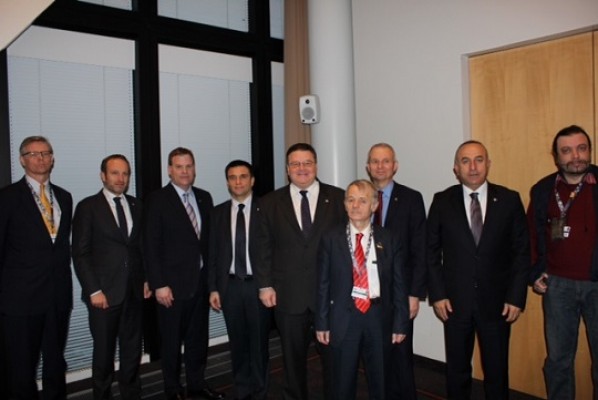
In the margins of the 21st OSCE Ministerial Council in Basel, Switzerland, on 4 December, Lithuania initiated a meeting of Ministers of Foreign Affairs and representatives from eight countries with Crimean Tatar leader Mustafa Jemilev and Andrew Yurov, Chairman of the Crimean Field Mission on Human Rights (Russia).
“We organised this meeting in order to express our solidarity with Crimean Tatars, to draw the attention of the international community to violations of human rights and the illegal annexation of Crimea. Violations of the OSCE’s fundamental principles and obligations are obvious in Crimea,” said Lithuania’s Minister of Foreign Affairs Linas Linkevičius.
M.Jemilev and A.Yurov informed the Ministers of Foreign Affairs of Lithuania, Denmark, Canada, Turkey and Ukraine, the Minister of State for Europe of the United Kingdom, representatives of the United States of America and Sweden about the ongoing persecution of ethnic Ukrainians, the intimidation of Crimean Tatars, violations of freedom of expression, freedom of assembly, freedom of religion or belief, property rights, searches of the homes of Crimean Tatars, the restriction of movement for the Ukrainian citizens between Crimea and mainland Ukraine, and of the right to use their mother tongue (Ukrainian) in education, etc.
Lithuania’s Foreign Minister expressed concern about the continuous violations of human rights, in particular the violations of the rights of national minorities in Crimea, which were reported by M.Jemilev, A.Yurov and the UN Human Rights Monitoring Mission to Ukraine.
“We must constantly raise the matter of the illegal annexation of Crimea and its consequences in the meetings of the OSCE and other international organizations, and call on Russia to ensure safe and unrestricted access to Crimea, to allow missions of the OSCE and other international organizations investigate violations of human rights,” said L.Linkevičius.
The most important item on the agenda is a grave European security crisis, resulting from Russia’s aggression towards Ukraine.
Social media


