


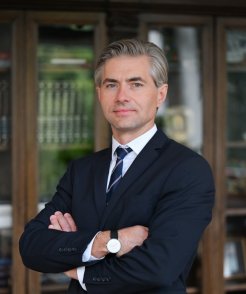
SPEECH BY ANTANAS VALIONIS LITHUANIAN MINISTER OF FOREIGN AFFAIRS TO FOREIGN AMBASSADORS ACCREDITED TO LITHUANIA ON THE OCCASION OF THE NATIONAL DAY OF 16 FEBRUARY (Vilnius, 16 February 2002)
Excellencies,
Ladies and gentlemen,
As we gather here today to celebrate the anniversary of Lithuania’s independence, I instinctively think of our compatriots who found hospitality and a home in many of your countries and worked side by side with your people to build the prosperity of your nations.
As our states build on the bilateral relations established or restored over the past decade,
we are gradually returning this hospitality to your nationals and are opening up to the cultures of other countries represented here.
We hope you feel at home with us. Thanks to your presence our capital is regaining its international character, which has been its defining feature since the very beginning.
Local Jewish, Belarussian, Russian, Tatar, Karaite, Polish and other communities have left a vivid trace in our history.
Today nationals of China, the United States, Germany, Britain, Turkey, Lebanon, Argentina, and many others – a total of some fifty countries – are living and working by our side, building our common dream, creating our common prosperity.
Ladies and gentlemen,
From the moment we regained independence, we chose the success story of Europe to guide us. Europe as embodied by the European Union, whose member we seek to become by 2004.
As our EU accession talks enter the decisive stage, as the NATO Prague summit approaches, bringing hope of a new enlargement which would embrace my country, one may hear an occasional voice saying: you candidates seek to join the old institutions, to enjoy the benefits and to offer little in return.
We are aware that the EU and NATO are not quite the same organisations that received our membership applications some years ago. As truly vital organisations, they evolve, they adapt to real life, they are a process in the making.
Lithuania wants to be an integral part of that process. We believe there is no better road to take than embracing the candidate countries that are ready for membership, committed to membership.
Because we as much as the current members desire that the EU and NATO build on their success story of the past half a century, further develop this unique area of peace and stability, and share its democratic experience and values worldwide.
Seeking to keep what has outlived its time is not in our interest. That would not be feasible, nor would it be beneficial.
At the same time, we believe that as the European Union evolves, solidarity should remain a cornerstone principle.
Because it was due to the method of solidarity and fair distribution of the benefits of democratic development that the Union’s weaker regions have improved their living standards and have made good much of the disadvantage they were in.
Like the previous enlargements, the next enlargement of the Union is about responsibilities, but also about new opportunities. It is about larger markets, new intellectual capacities, and greater weight internationally.
We are ready and willing together with the current members to share in designing the future Union, in order to make it more responsive to the needs of its citizens, more effective and capable of dealing successfully with the challenges of the 21st century.
As we in Lithuania launch the debate on the future of the Union, we naturally take into consideration the concerns of our people. We tackle common fears regarding our accession and look into the reasons behind them.
As can be seen from the latest opinion polls, we’re on the right track. Six out of 10 inhabitants would vote in favour of our country’s membership in the EU. It is an encouraging sign, which gives us an impetus to proceed further with the implementation of our goals.
Of course, the EU’s assistance is essential. Therefore, we appreciate, for example, that Ignalina’s nuclear power plant has been given a separate line in the Community expenditure for EU enlargement.
But the success of accession depends above all on us. It is us who can make sure that membership pays off. Through our fulfilment of pre-accession commitments as well as through the strengthening of administrative and judiciary capacities.
Likewise, we do not seek to enter NATO to keep it unchanged. We seek to enter the Alliance for the sake of a Europe whole and free.
We all have been witness to the dramatic changes in the world over the past few years. And each time, the Alliance has managed to produce prompt and adequate responses to these changes, while at the same time maintaining its effectiveness.
It admitted new members. Through MAP, it put in place a mechanism of continuous practical preparations for the democracies actively seeking membership. It develops an ongoing dialogue with countries that will not be applying for membership in the near future, or perhaps never at all.
Besides the core function of collective defence, other activities took prominence, such as out-of-area peace support and other international crisis management operations.
It is this vitality, this adaptability of the Alliance that we seek to reinforce as we prepare for membership. Even if we still have a ways to go, we think and act as allies. For just a short time ago, in a most tragic way, the events of September 11 brought home the stark reality of new risks and threats that lay ahead.
Reaffirming the importance of solidarity and co-ordination among states, especially those bound by common values, the democratic tradition,
and the rule of law.
And highlighting the benefit of further robust enlargement as a means of locking in stability in our region, of ensuring the Alliance’s dynamism, political sustenance, and validity in today’s world.
Russia is there, eager to develop a new quality of relations with the Alliance. Building this new quality is a benefit to us all. Lithuania joining the Alliance is a benefit to us all.
For today, more than ever before, we understand the importance of being and acting together, because the new threats stop at no boundaries, fear no borders.
In a world where globalisation has ever increasing weight, no one can stand alone against international terrorism, international crime, cyber crime, drugs and human trafficking, degradation of the environment, or spreading diseases.
As a small country, we cannot claim a global role.
However, we reaffirm our strong commitment to continue playing an active role in the region, which has reached a state of remarkable stability and peace.
We shall build on the co-operation formats that already exist, such as the strategic partnership with Poland, the Baltic Three, the Nordic-Baltic Eight, the Council of the Baltic Sea States, and the US-Baltic Partnership Commission.
As a founder of the Vilnius 10 process, Lithuania will continue fostering its spirit, up to the Prague summit and beyond.
We shall make sure that our further integration into the Euro-Atlantic organisations opens up new opportunities to the entire region.
Specifically, we see co-operation with Kaliningrad Region as a window of opportunity and a model for wider co-operation between Russia and the enlarging EU.
We shall use our integration experience to further involve Ukraine in European developments.
We shall continue co-ordinated efforts at promoting democratisation in Belarus.
Lithuania will build on the experience of the presidency of the Council of Europe Committee of Ministers, which gave us additional insight into the issues in areas where peace and stability are still in the making, such as south-eastern Europe or the Caucasus.
Notably, in order to promote the positive experience of the Baltic Sea states’ good neighbourly co-operation, we chose the subject of “Regional Co-operation: Its Impact on Stability and Democratic Reforms in Europe” for the coming session of the Council of Europe Committee of Ministers, to be held in Vilnius early in May of this year.
At the same time, we shall seek to expand the horizons of our foreign policy, strengthening our presence on the various continents. The opening of Lithuanian embassies in Argentina and Egypt late last year was a step in this direction. By the way, the latter is our first ever in the Arab world and on the African continent.
The pending appointment of non-resident ambassadors to Asian-Pacific, African and Arab countries – including the Republic of Korea, the Philippines, Indonesia, Malaysia, Pakistan, Tunisia and others – will be another.
We cannot shut ourselves in from the rest of the world. Ignoring the problems of others does not make them disappear, nor does it make our own environment safer or more secure.
Together, we should encourage international co-operation and take a fresh look into how we can best use the international organisations for working out specific, well-targeted approaches to deal with issues that trouble the world today.
Growing co-operation in trade matters, cultural exchange programs, human and, specifically, youth exchanges, a deepening dialogue between civilizations – these are the natural steps to further understanding.
We hope to continue sharing our culture and our heritage with your countries. And we hope to be doing this with your personal help and support, Excellencies. For yours is a great mission indeed: to exalt humanity through co-operation.
Thank you.
humanity through cooperation. Thank you.
Social media


